


Taste Buds in Numbers: Thousands of Them, Rebuilt Every Week or Two

In 1965 two physiologists, L. M. Beidler and R. L. Smallman, gave rats colchicine, a drug that stops cells from dividing. Nothing else changed: the same tongue, the same nerves, the same food. Yet within 3 hours the taste nerve’s response to chemicals had fallen by 50 %. Then they marked newborn cells with a radioactive label and watched them slip into the taste buds and drift slowly toward the centre. The average taste cell, they calculated, lived about 250 hours, give or take 50. Roughly ten days.
A sense we take for granted turned out to be a building site that never closes. Here is your tongue in numbers: how many taste buds you have, how many cells sit in each one, how long those cells live, and why two people can taste the same spoonful differently.
How many taste buds do you have?
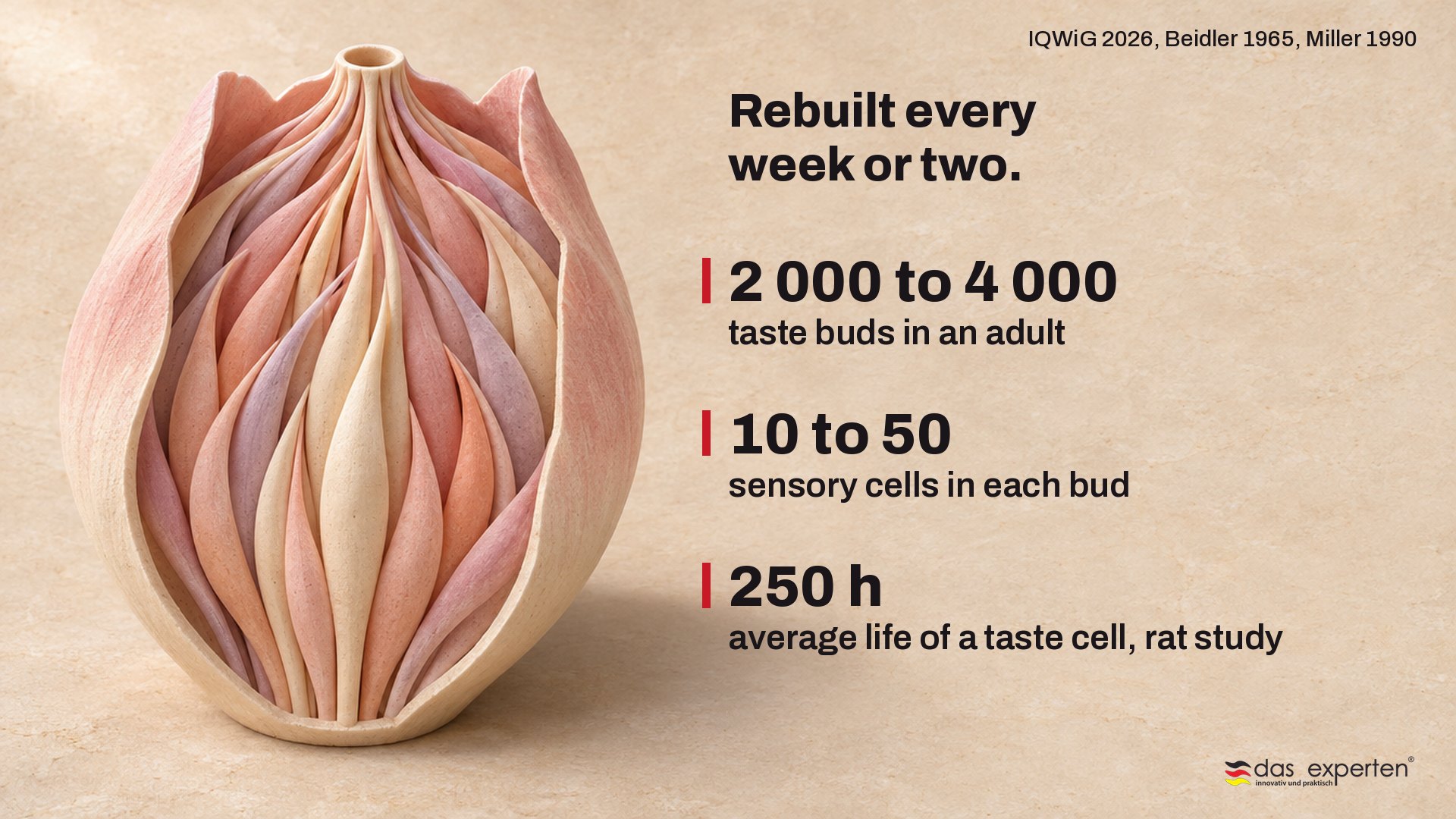
An adult has between 2 000 and 4 000 taste buds. That figure comes from InformedHealth, the patient service of Germany’s Institute for Quality and Efficiency in Health Care, in its page on taste updated in September 2026. Most of them sit on the tongue, tucked into the walls and grooves of small bumps called papillae. A few hide elsewhere: at the back of the throat, on the epiglottis and even in the upper part of the food pipe.
The papillae split the work. Across the surface stand 200 to 400 mushroom shaped fungiform papillae, each holding 3 to 5 taste buds. At the very back sit only 7 to 12 large circumvallate papillae, and along the sides about 20 foliate papillae, both packed with far more buds. Inside every bud are between 10 and 50 sensory cells. Multiply it out and the tongue carries tens of thousands of cells whose only job is to tell you what is in your mouth.
How often do your taste buds change?
A keyword tool counts about 1 600 searches a month in the United States for one question: do your taste buds change every 7 years? The real clock runs far faster. In the 1965 rat study the average taste cell lived about 250 hours, though some died much sooner and others lasted much longer. For people, the German health institute says it plainly: the sensory cells in the taste buds are renewed once a week. Direct counts in living human tongues are rare, so read “every week or two” as an honest range, not a stopwatch.
The bud stays; its cells come and go. New cells are born in the lining around the bud, move inward and take over from the old ones. That is the likely reason a tongue scalded by hot coffee gets its taste back within days rather than years: the damaged cells were already on the replacement list.
Why do some people taste more than others?
In 1990 two researchers, I. J. Miller and F. E. Reedy, counted taste pores on the tip of the tongue in 16 people with a video microscope. The denser half averaged 374 pores per square centimetre; the sparser half averaged 135, almost three times fewer. Then both groups rated the same solutions. The dense tongues rated sugar at 196 % of the intensity the sparse tongues reported, and salt at 135 %. Same spoon, different mouth.
So if you have ever argued that a dish is too sweet while someone across the table finds it bland, you may both be right. You are not reading the same instrument.
Why bitter gets the most sensors
Humans perceive thousands of compounds as bitter, yet only about 25 bitter taste receptors have been identified. In a study published in 2010, a German team tested all 25 against 104 bitter chemicals. Just 3 receptors together detected about half of the substances, while some compounds switched on as many as 15 receptors at once. Bitterness is how the body flags food that may be harmful, and the tongue spends its largest sensor kit on that warning.
The tongue map that never existed
You may remember a school diagram with sweet on the tip and bitter at the back. InformedHealth calls it a long held misconception, based on an incorrect reading of an old illustration of the tongue. There are no separate zones for each taste.
What the numbers mean for you
The cells you taste with this morning are, on average, younger than the milk in your fridge. Your tongue is not a fixed instrument. It is a surface that rebuilds itself every week or two, set to a density you did not choose, with its biggest sensor kit tuned to warn you. The next time a burnt tongue or a cold dulls your food, remember the schedule: the replacements are already on their way.
2 000 to 4 000 taste buds, 10 to 50 cells in each, renewed in days. Tonight’s dinner will be judged by cells that, for the most part, were not there a month ago.