


Does Mouthwash Raise Blood Pressure? Three New Studies and the Bacteria on Your Tongue

Every evening, after the brush, comes the cap of blue liquid: thirty seconds of burning, a clean mint finish, the feeling of a job done properly. Somewhere on your tongue, at that moment, a small and very useful community of bacteria is having the worst half minute of its day. Some of those bacteria help your body make a molecule that relaxes your blood vessels. So the question is fair: does mouthwash raise blood pressure?
Three studies published between 16 September and 12 October 2026 looked at exactly this, from three different angles. Here is what each found, and what it means for the bottle on your shelf.
Why mouthwash and blood pressure are connected at all
The link runs through your saliva. Nitrate from vegetables, beetroot and spinach in particular, is pulled out of the blood and concentrated in saliva. Bacteria living in the grooves of the tongue convert that nitrate into nitrite. You swallow it, and part of it becomes nitric oxide, a gas that tells blood vessels to widen. Your body has other routes to nitric oxide, but this one depends on microbes you share your mouth with.
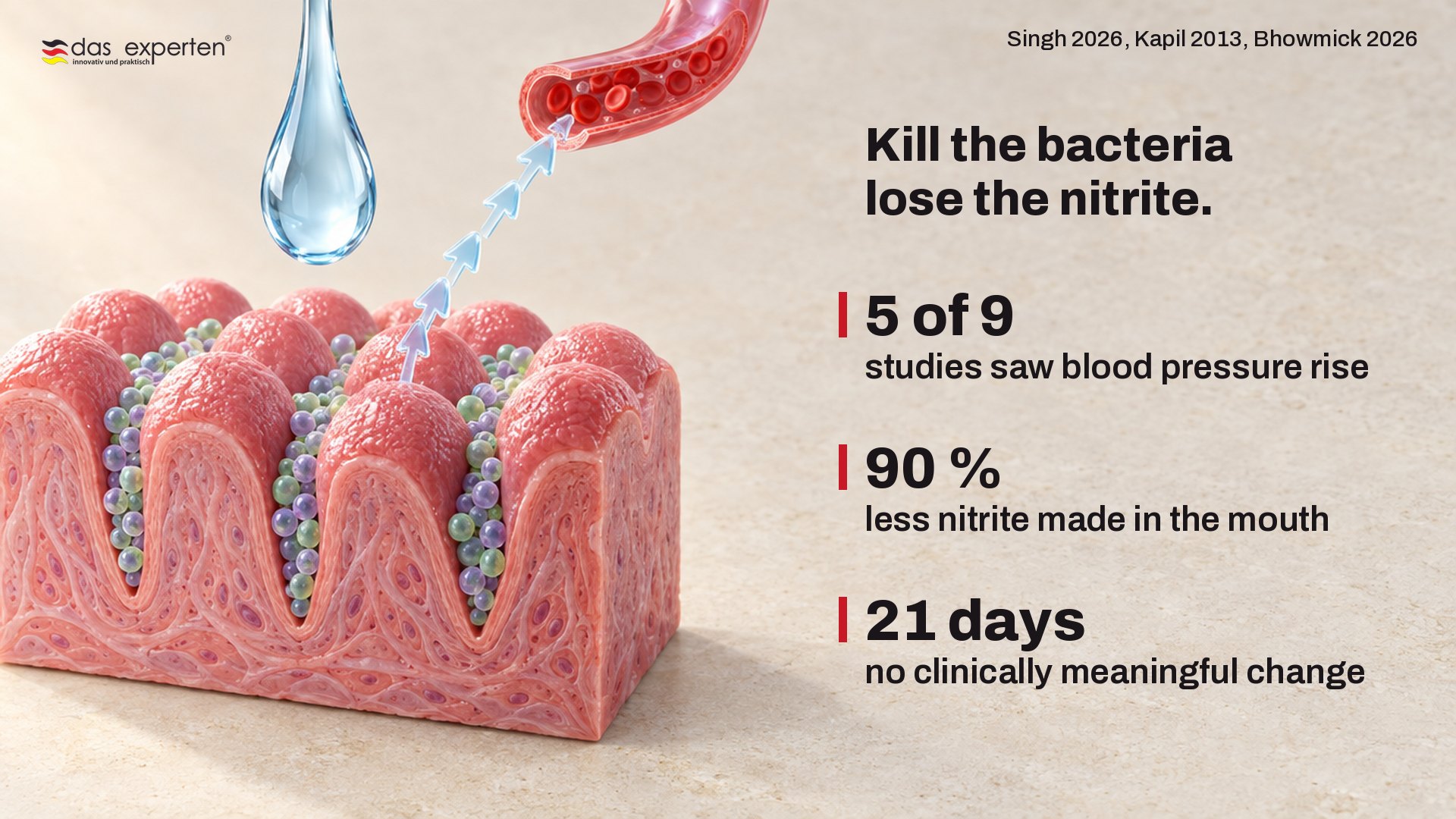
In 2013 a London team tested what happens when those microbes are switched off. 19 healthy volunteers rinsed with chlorhexidine, a strong antiseptic, for 7 days. Nitrite production in the mouth fell by 90 %, nitrite in the blood by 25 %, and blood pressure rose by 2 to 3.5 mmHg, starting on the first day. A small number, but a clear mechanism.
September 16: nine studies, two answers
A scoping review in BMC Cardiovascular Disorders gathered every study since 2014 that measured blood pressure in adults after antibacterial mouthwash. From 51 candidates, 9 met the bar. 5 found a significant rise in blood pressure; 4 found none. The authors judged the studies of good quality, yet the designs were too different to pool: different rinses, different durations, short washouts. Their conclusion is unusually blunt: no firm conclusion can be drawn yet. The review also reminds us why it matters: around 36 % of adults in the United States use mouthwash every day.
October 3: chlorhexidine rearranges the whole community
In Riga, researchers gave people with gum disease one of three rinses twice a day for 14 days: water, an essential oil of coriander, or chlorhexidine 0.12 %. They read the genetic material of every microbe in 54 saliva samples from 27 people. Chlorhexidine reshaped the salivary microbiome broadly and lowered its diversity. The coriander rinse could not be told apart from water. The study did not measure blood pressure, but it shows the scale of what a strong antiseptic does: it does not pick out the bad bacteria, it thins out the neighbourhood.
October 12: 90 people, 21 days, a calmer number
The newest trial comes from Kolkata. 90 adults with gingivitis rinsed with 10 ml of saline, chlorhexidine 0.2 % or octenidine 0.1 % for 21 days and were followed for 42. Both antiseptics worked on the gums: clinical scores fell by 29 to 52 % and salivary bacteria by more than 92 %, while salivary nitrate moved the opposite way, the sign that fewer bacteria were converting it. Systolic pressure rose slightly in every group, saline included, and the change was not clinically meaningful. Pulse pressure rose in the antiseptic groups and was back to baseline by day 42. Octenidine worked as well as chlorhexidine with fewer side effects.
So, does mouthwash raise blood pressure?
Here is the honest reading of the three. A strong antiseptic rinse clearly suppresses the bacteria that recycle nitrate; that part is settled. Whether this moves your blood pressure enough to matter is not settled: small rises in short trials, no meaningful change in the October one. The worrying signal comes from observation, not experiment. In Puerto Rico, among 540 overweight adults without hypertension, those who rinsed twice a day or more developed it 1.85 times as often over three years as those who rinsed less. Observation cannot prove the rinse caused it.
What follows is practical rather than alarming. If your dentist prescribed chlorhexidine for a defined period, finish the course. If you rinse twice a day simply out of habit, ask yourself what job the rinse is doing that brushing and cleaning between the teeth do not. Mechanical cleaning removes plaque without wiping out the whole community. For tight gaps we make WAXED MINT, a 50 m polyester floss with a microcrystalline wax and peppermint coating, made for tight contacts. And if you already watch your blood pressure, mention your rinse to your doctor, the same way you would mention any daily habit.
Your tongue keeps a small chemical workshop that helps your blood vessels relax. Clean the teeth, not the whole neighbourhood, and keep the strong antiseptic for when you actually need it.