


Dry Mouth: In 652 a Tang Physician Wrote That Saliva Protects Teeth. Emperors Chose Mercury Instead
Around the year 652, in Tang China, a physician of about seventy finished a book he called Essential Formulas Worth a Thousand in Gold. Sun Simiao preferred to live far from the court and spent his life collecting cures, thousands of them went into the thirty scrolls. Most of the book is about fevers, wounds and childbirth. But in the chapter on nurturing life there is a line so plain it is easy to read past: when you finish eating, rinse your mouth several times; then the teeth will not decay and the mouth will be fragrant. A little further on, in the breathing exercises, comes a stranger instruction: tap your teeth together again and again, and drink the jade liquid. The jade liquid was saliva.
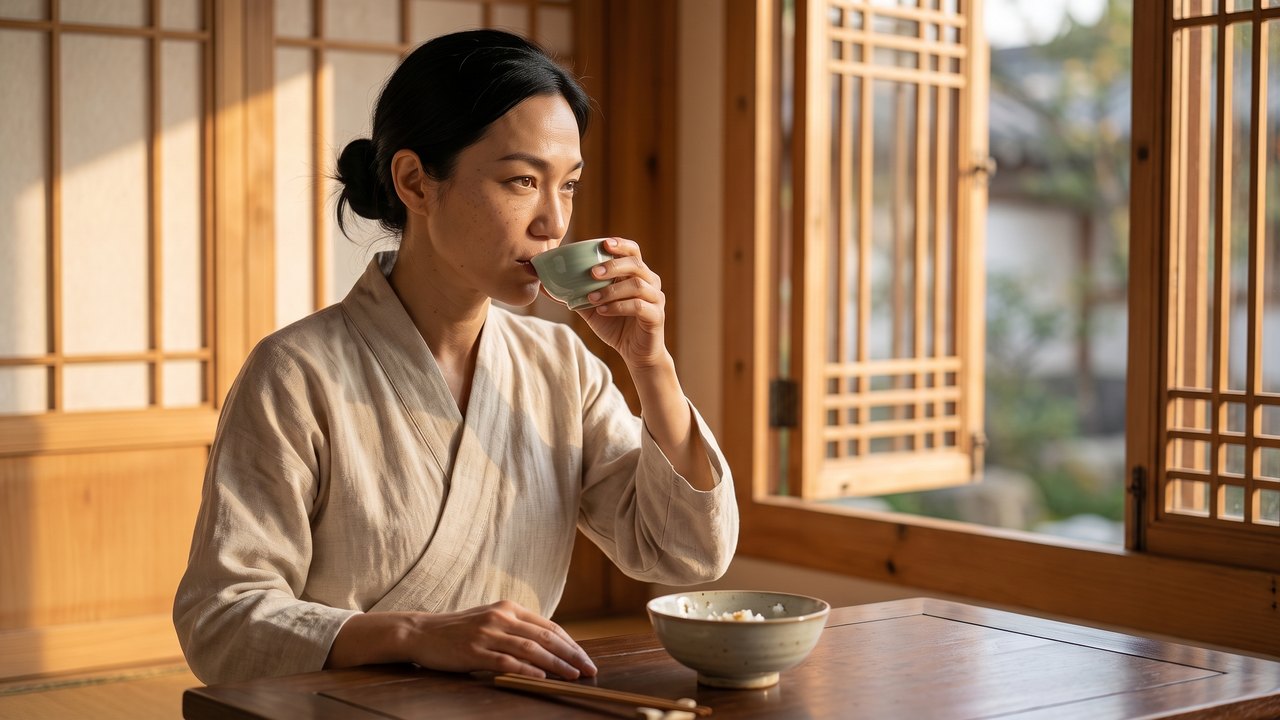
Picture the house that followed the rule. The rice bowl pushed aside, a small celadon cup of water lifted after the meal, the cool water moving across the teeth, the quiet click of teeth, and then a deliberate swallow, not spat out, kept. If you have ever woken with a mouth like paper, you already know which of the two states feels like health.
The same hand wrote other prescriptions for a long life. Around 640, Sun Simiao recorded fourteen alchemical elixirs he considered successful; most of them, by modern reading, were poisons built on mercury and lead. Two centuries later the Tang emperors took that road with full conviction. Xianzong, Muzong, Jingzong, Wuzong, Xuanzong, five rulers of the ninth century are recorded as dying after elixirs meant to make them immortal. The expensive recipe killed emperors. The free one was sitting in the chapter about dinner.
Dry mouth: what Europe was looking for instead
In Europe, the respectable explanation for a rotting tooth was a worm. It lived in the tooth, it gnawed, and it could be smoked out. The idea outlived Sun Simiao by a thousand years: only in 1728 did the Parisian surgeon Pierre Fauchard, in Le Chirurgien Dentiste, argue the worm out of serious dentistry. Nobody in that story was thinking about the liquid already in the mouth. Europe was hunting an enemy inside the tooth. China had written down the defence outside it.
How a Tang physician guessed what saliva does
Sun Simiao had no microscope and no word for acid. He had something older: thousands of mouths. A physician who treats the old, the feverish and the dying sees the same sequence again and again, the mouth dries, the breath turns, the teeth go. The Daoist tradition he belonged to had its own theory of why. Saliva was an essence of the body, one of its precious fluids; you did not waste it, you circulated it and swallowed it, and tapping the teeth called it up. The theory was wrong in its language and right in its results: keep the mouth wet, wash food off the teeth, and decay slows.
So why did the lesson vanish? Not because nobody wrote it down. It was written, in a standard medical work, in clear words. It vanished because it was written in the wrong language for the wrong paradigm. To European readers it was untranslated Chinese; to Chinese readers it was a matter of vital essence, filed next to breathing exercises and, in the same author’s other books, next to mercury. A rule about rinsing and swallowing does not look like medicine. It looks like manners. And manners are the first thing a civilisation forgets to study.
The long way back to saliva
Science came back to the jade liquid slowly, from the other end. Once the worm was gone, dentistry spent two centuries on the tooth itself, its enamel, its bacteria, its sugar. Saliva entered the story as the background. Only when physiologists began measuring it did the background turn out to be a system. A review from Copenhagen, London and Gothenburg in 2018 sets it out: saliva is made by 3 pairs of major glands and by hundreds of minor ones; it protects the teeth and the lining of the mouth, it is needed to chew, swallow and speak, and it keeps the community of microbes in balance. When a disease or a medicine cuts the flow, the bill arrives as dry mouth, tooth decay and fungal infection.

And the bill is not rare. In the same year, researchers in Brazil pooled 29 population studies of dry mouth and arrived at a prevalence of 22.0%, roughly one adult in five, and higher among older people. Many common medicines list a dry mouth as a side effect, which is one reason the number rises with age: the older the body, the more prescriptions it carries. Sun Simiao’s patients would have recognised the mouth. They simply had a different word for the fluid it was missing.
Ginger and saliva: the molecule that closes the gap
The newest piece of the story was published this year. In 2026, a team in Japan let volunteers hold ginger juice in their mouths and measured what came out. Compared with distilled water, ginger juice raised total salivary secretion, and raised it more than citric acid or glutamate, the sour and savoury tastes most people would bet on. The authors analysed the juice: its pungent components were 6 shogaol and, above all, 6 gingerol, and they write that the extra saliva may have been induced by exactly these. An older trial in Iran points the same way: 20 people with type 2 diabetes and a dry mouth produced significantly more saliva after a ginger spray than after a placebo. Small studies, honestly sized, but the direction is the one the Tang physician would have expected.
Now the part that is yours. Tomorrow morning you will either wake with that paper dry tongue or you will not. After lunch you will either rinse, or let the meal sit on your teeth until evening. None of this is a question of fashion. It is a question of which century runs your mouth: the one that swallowed mercury, or the one that wrote down the jade liquid.
Our GINGER FORCE toothpaste contains ginger root extract at 1%, with sodium pyrophosphate and with sodium lauroyl sarcosinate instead of SLS. Let us be exact about what is and is not known: the saliva studies above used ginger juice and a ginger spray, not a toothpaste, and nobody has measured saliva with our tube. What the paste carries is the molecule, in a routine you already keep twice a day. The rest of the rule costs nothing: rinse after eating, as Sun Simiao wrote, and if your mouth stays dry for weeks, ask your doctor which of your medicines might be the cause. This week, try one change, the rinse after lunch, and notice the afternoon.
Emperors drank mercury to live forever; their physician had already written that the elixir was in their own mouths.