


Bromelain: Why Fresh Pineapple Stings Your Tongue, and What That Means for Your Teeth
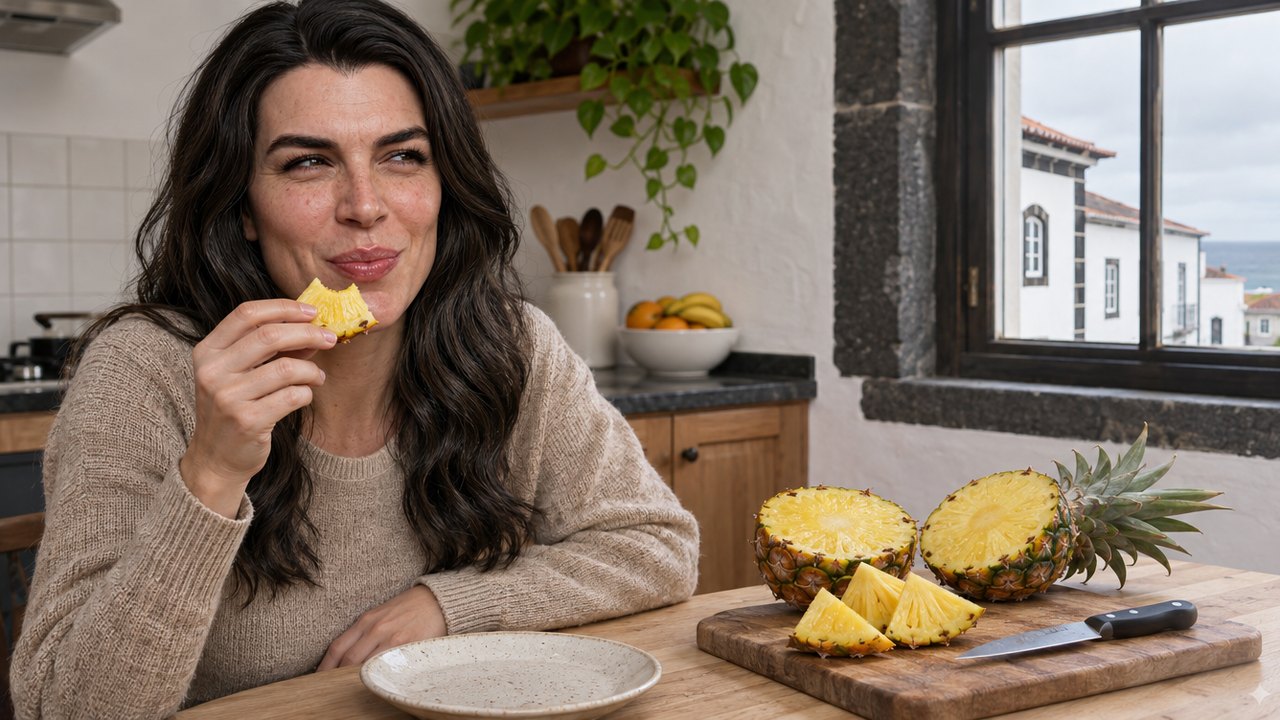
Cut a ripe pineapple, eat three or four pieces in a row, and something odd happens. The sweetness is still there, but the tongue starts to prickle, then to feel raw, as if it had been lightly sanded. Most people blame the acid. The acid is only half of it. For a few minutes, in a very small way, the fruit is digesting you.
Cooks know the other half of the story without knowing the chemistry. A jelly made with fresh pineapple never sets. Make the same jelly with canned pineapple and it sets perfectly. Same fruit, same sugar, same gelatin. The only difference is heat: the can has been cooked, and whatever was eating the gelatin did not survive the cooking.
That something has a name, bromelain. And here is the question worth a few minutes of your morning: why would anyone put the substance that makes a pineapple sting your tongue into a toothpaste?
A fruit that digests meat
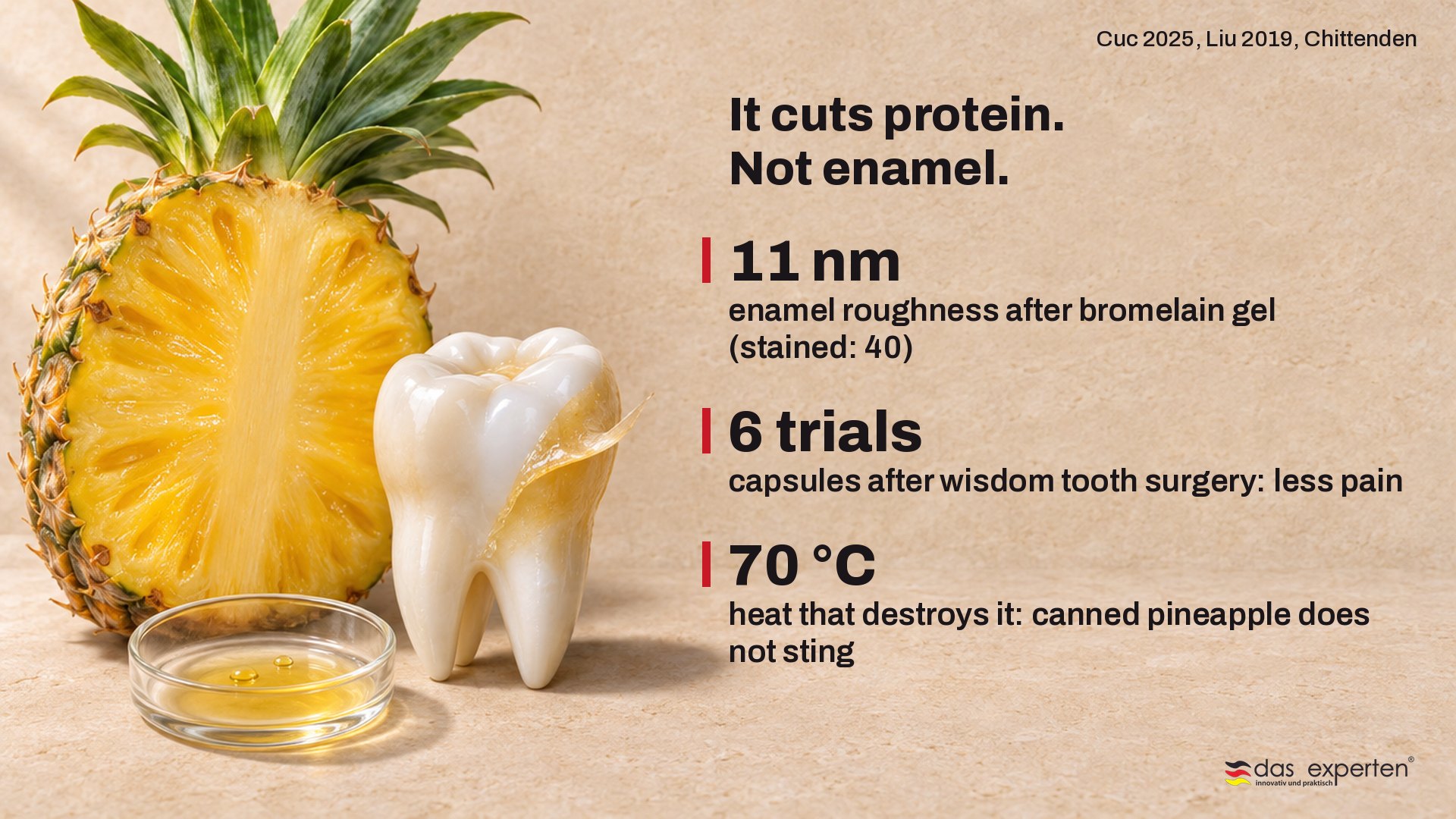
The first person to take the question seriously was not a dentist. In the early 1890s, at Yale, the chemist Russell Chittenden set out to find what was hidden in pineapple juice. He worked with two students; one of them, Elliott Joslin, later became one of the best known diabetes doctors in America. Their report, in the Transactions of the Connecticut Academy of Arts and Sciences, was blunt: fresh pineapple juice is a very constant and powerful digestant of protein. It worked best at 50 to 60 °C, still worked at 30 °C, and was destroyed at 70 °C. They named the ferment bromelin, after the plant family of the pineapple, the bromeliads. Today we call it bromelain, and we know it is not one enzyme but a small family of protein cutters, taken from the stem and the fruit of the plant.
Read those temperatures again and the jelly mystery is solved. A can of pineapple has been heated past the point where the enzyme survives. A fresh slice has not. And your mouth, at about 37 °C, sits well inside the range where bromelain still works.
So why does your tongue sting?
The surface of your mouth is protected by a thin layer of mucus, and mucus is built on proteins. The leading explanation, summarised in 2023 by McGill University's Office for Science and Society, runs like this: bromelain thins that protective layer, and then the acid of the juice reaches tissue that is suddenly less covered. Pineapple also carries tiny needle shaped crystals of calcium oxalate, and they may add their own scratch. Nobody has run a careful trial on human tongues. What exists is a 2014 study in caterpillars, where the needles and the enzyme together did more damage than either alone. So the honest answer is: protein cutting plus acid, with a likely assist from the needles.
Hold on to the first half of that answer. Bromelain cuts protein. It does not dissolve mineral. That single fact is what makes it interesting for teeth.
What protein has to do with stains
Within minutes of brushing, saliva coats every tooth with a thin film of proteins, the pellicle. You cannot see it and you cannot avoid it; it is part of how the mouth protects enamel. The trouble is that it is also sticky. The dark pigments of tea, coffee, red wine and berries do not grip bare enamel very well, but they grip that protein film easily. Much of what we call surface staining is colour held by protein.
That is where a protein cutter earns its place. In a laboratory study published in 2025, researchers stained 80 extracted human teeth with coffee or with fruit juice and then treated them with gels made from papain or bromelain. Both enzyme gels removed stain better than a commercial whitening gel used for comparison. Under the microscope, healthy enamel had a roughness of about 10 nanometres; after staining, about 40. Bromelain brought the juice stained surface back to about 11. Papain did best on coffee, bromelain on juice.
Now the limits, because they matter. These were extracted teeth in a laboratory, and the gels stayed on them for hours, not for the two minutes of a brushing. It is evidence for a mechanism, not proof of a whiter smile. And bromelain does not bleach: it removes colour bound to protein, it does not change the colour of the tooth itself.
The dentist's chair has a second story
Bromelain has been tested in dentistry in another form altogether: swallowed as a capsule, after surgery. After the removal of wisdom teeth, three separate reviews of the trials published in 2018 and 2019 found that it eased pain, though they disagreed on swelling. One pooled six trials and saw less swelling and less pain by the seventh day; another pooled five trials and 252 patients and saw less pain at two to three days, but no clear effect on swelling. In 2023 a small trial in Iran gave 28 patients bromelain or a placebo for a week after gum surgery: five weeks later, bleeding on probing was 0 % in the bromelain group against 35.7 % with placebo, while the gum inflammation score did not differ. Modest, mixed and honest. And all of it about capsules, which is a different thing from a paste you spit out.
One more honest line. Bromelain is a protein. If pineapple gives you more than a tingle, if your lips swell or your throat itches, read labels on everything that contains it, toothpaste included.
What bromelain does in a tube
Now picture tomorrow morning. You will brush for two minutes, at about thirty seven degrees, over a film of protein that has been collecting colour since yesterday's coffee. You can scrub that film off with a hard abrasive and take a little enamel with it, or you can cut the protein that holds the colour.
Our Das Experten INNOWEISS takes the second route. It is a five enzyme toothpaste for low abrasion stain and biofilm removal: dextranase, invertase, glucose oxidase, papain and bromelain, with an abrasivity of RDA <30, no fluoride and no SLS. In it, bromelain works next to papain on the protein side of surface stain while you brush. It is not peroxide bleaching, and it will not change the natural colour of your teeth. Look at what you squeeze onto your brush this week.
The sting on your tongue is the proof: bromelain cuts protein, and on a tooth, protein is exactly where the stain holds on.