


Are Root Canals Bad for You? A Century Old Fear, Checked Against the Evidence
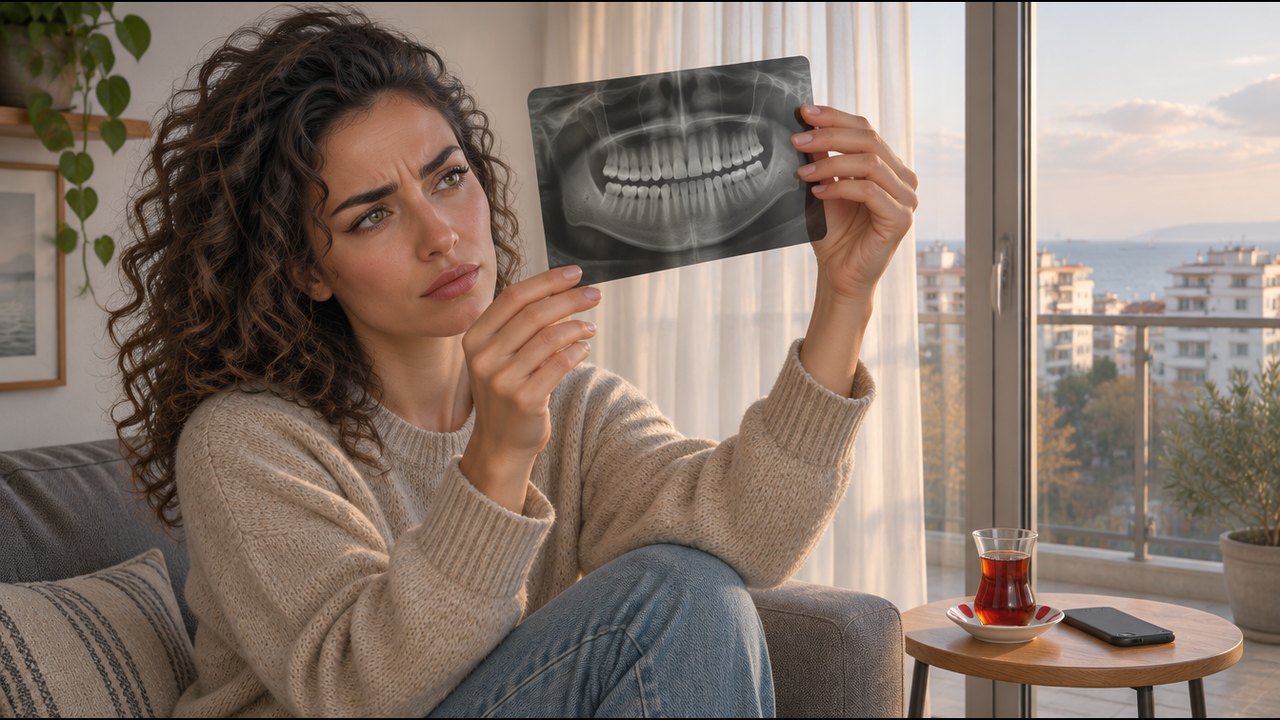
Somewhere today a person is sitting in a dental chair, hearing the words root canal, and remembering something they read online: a dead tooth, they were told, quietly poisons the body. Heart disease, arthritis, even cancer. Some of them ask the dentist to pull the tooth instead.
To understand where that fear comes from, you have to go back more than a hundred years, to a lecture hall in Montreal and a laboratory full of rabbits. And to understand why it is wrong, you have to look at what happened when somebody finally counted.
A lecture, a theory and a laboratory of rabbits
In 1900 the British physician William Hunter argued in the British Medical Journal that infection in the mouth, which he called oral sepsis, was behind a long list of illnesses. In 1910, in a lecture at McGill University, he went further and named some of the worst cases of anemia, gastritis, colitis and obscure fevers. The idea became known as focal infection theory: a small hidden focus of germs, in a tooth or a tonsil, seeds disease everywhere else in the body.
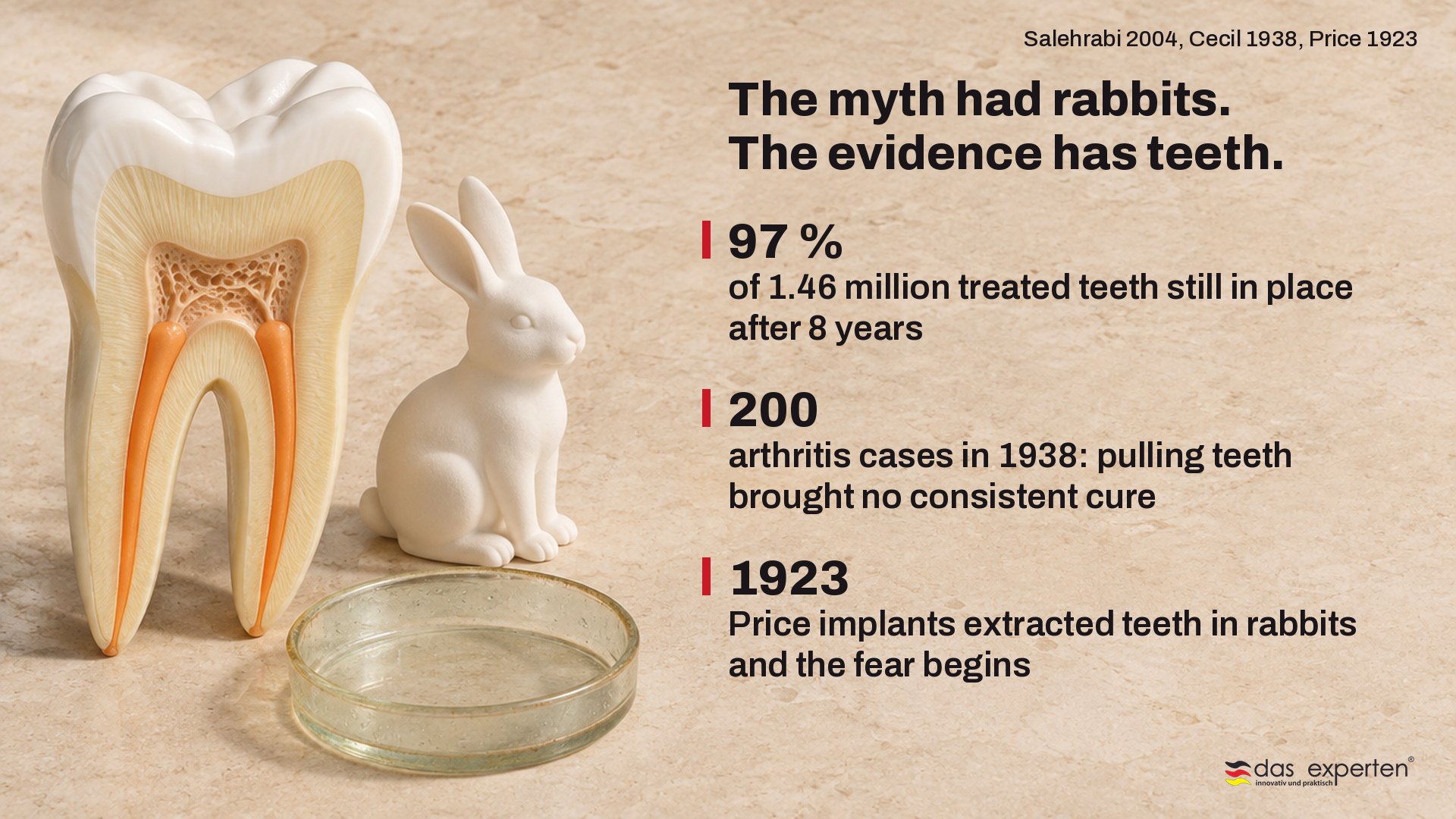
The American dentist Weston Price turned the theory into a programme. In 1923 he published two volumes, Dental Infections, Oral and Systemic, built on some 25 years of research. His best known method was simple and alarming: he took teeth extracted from sick patients, implanted them in healthy rabbits, and reported that the rabbits developed the same heart and joint diseases. In 1925 his side of a famous debate put it bluntly: practically all infected pulpless teeth should be extracted. Across the English speaking world teeth were pulled by the million, healthy ones among them, and tonsils went with them.
What happened when someone checked
The theory had one weakness. It was rarely tested against a fair comparison. In 1927 Price's work was criticised for faulty bacterial technique: a tooth that has passed through a mouth, a pair of forceps and a laboratory bench carries plenty of passengers that were never inside it. In 1938 the physicians Russell Cecil and Murray Angevine reported on 200 cases of rheumatoid arthritis and found no consistent cures from pulling teeth or removing tonsils. In 1940 an influential review in JAMA warned that clearing out supposed foci was itself an experiment with its own hazards.
The decisive point came in a JAMA editorial in 1952: foci of infection were as common in apparently healthy people as in people with disease. If almost everyone carries the suspect, the suspect explains nothing. By the 1950s the theory had been largely abandoned.
The numbers that replaced the rabbits
Modern evidence comes from patients, not rabbits, and in very large numbers. In 2004 researchers at the University of Southern California followed 1,462,936 teeth that had a first root canal treatment, in 1,126,288 patients from all 50 US states, for 8 years. 97 % of those teeth were still in the mouth. Of the few that were later extracted, 85 % had never received a full crown.
And cancer? In 2013 a study in JAMA Otolaryngology compared 399 people with newly diagnosed head and neck cancer with 221 people without cancer. The people with cancer had fewer root canal treated teeth, not more. After adjustment the trend still pointed the same way, though it fell short of statistical significance. The authors never claimed that root canals protect against cancer. They simply found no trace of the harm the myth promises.
The real risk is the tooth left untreated
Here is the twist. The myth gets one thing almost right: an infection sitting at the tip of a tooth root is not good for the rest of you. Dentists call it apical periodontitis. A 2022 review pooled 15 studies and found a weak link between this infection and heart and blood vessel disease in cross sectional studies (odds ratio 1.53), but not in the case control or cohort studies, and the authors warned against reading cause into it. In 2025 a team at King's College London followed 65 patients for 2 years after successful root canal treatment: their blood showed better glucose and fat metabolism and a lower inflammatory burden than before.
Put the two halves together and the myth turns inside out. The danger lives in the infected tooth. The root canal is how the infection is taken out.
The old fear still finds new screens. In 2019 a documentary called Root Cause, which blamed root canals for chronic disease, appeared on Netflix. The American Dental Association, the American Association of Endodontists and the American Association for Dental Research wrote to the platform, and the film was removed soon after, without a public reason.
What to do with a treated tooth
If you have a root canal treated tooth, the practical lessons come straight from the numbers. Get the crown your dentist recommends: most of the treated teeth that were lost had none. Keep the gum line around that tooth clean, because a treated tooth can still lose its seal and its support to new decay and gum disease. And brush there gently. Our Das Experten SENSITIV is an ultra soft brush with DuPont Tynex® filaments, made for gentle pressure at the gum line, where a crowned tooth meets the gum.
The rabbits made a frightening story. 1.46 million teeth wrote the ending: a root canal removes an infection, and the tooth it saves is still yours.