


Antibacterial Mouthwash and Your Oral Microbiome: 6 Daily Antiseptics, Checked

An antibacterial mouthwash promises one thing on the bottle: it kills germs. What the bottle does not say is which germs, and what moves into the space they leave. Your mouth is not a surface to sterilise. It is home to hundreds of species of bacteria living in a community, the oral microbiome, and most of them are neighbours, not enemies. Some even do a job for the rest of your body.
So the useful question is not whether an antiseptic works. Most of them do, on plaque. The question is what each one costs the community, and whether you need it every day. Here are the six antiseptics people most often use daily, in a rinse or in a paste, checked against the trials.
1. Chlorhexidine: the strongest rinse, and the biggest shake up
Chlorhexidine is the antiseptic dentists reach for after surgery or for a bad flare of gum disease, and it earns that place. In a network analysis of six month trials by Escribano and colleagues in 2016, chlorhexidine and essential oils had the largest effect on plaque of all the rinses compared.
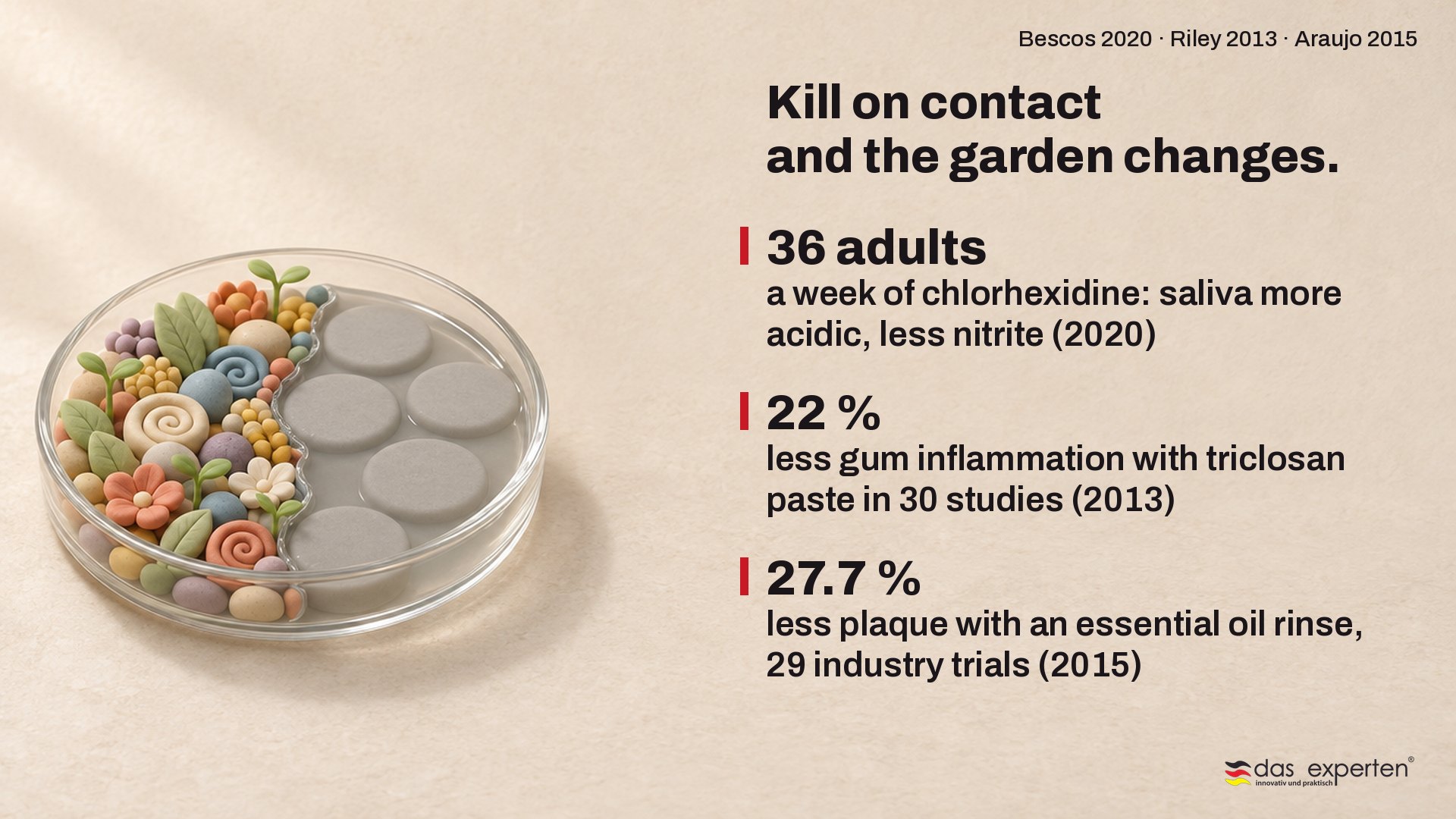
Then a team in Plymouth looked at what it does to a healthy mouth. In 2020 Bescos and colleagues had 36 healthy adults rinse twice a day with a placebo for a week, then with chlorhexidine for a week. The salivary microbiome shifted sharply: some groups of bacteria grew, others shrank. Saliva became more acidic and held less buffer, lactate and glucose in saliva rose, and nitrite in saliva and in blood fell. Acid favours the bacteria behind cavities, and nitrite is the raw material the body uses to make nitric oxide, which helps relax blood vessels. Chlorhexidine also tends to stain teeth more than its milder rival. Verdict: a short course when a dentist prescribes it, not a habit for a healthy mouth.
2. Cetylpyridinium chloride: milder, and still not neutral
Cetylpyridinium chloride, CPC on the label, is the antiseptic in many everyday rinses. It does real work. A 2020 review by Langa and colleagues pooled 8 trials of at least 6 weeks and found less plaque and less gum inflammation between the teeth than with a placebo rinse. A 2025 review from Amsterdam went further: in people who also brushed, CPC and chlorhexidine did not differ for plaque or gingivitis, and chlorhexidine stained more.
Milder does not mean invisible to the community. In a Japanese trial of 52 adults, three weeks of a CPC spray changed the bacteria in saliva and on the tongue, with one genus taking the lead. That study was funded by the maker of the spray, which is worth knowing. Verdict: a reasonable helper when cleaning between the teeth is hard, but it still rearranges the microbiome.
3. Essential oils: strong on plaque, mostly in the makers’ own trials
Thymol, eucalyptol, menthol and methyl salicylate are the classic essential oil rinse. The headline numbers are good: a 2015 analysis by Araujo and colleagues combined 29 trials of six months or more and found that adding the rinse to brushing and flossing cut plaque by 27.7 % and gingivitis by 16.0 % compared with brushing and flossing alone.
Read the methods line, though: every trial in it was sponsored by industry. That does not make the result false; the independent network analysis above also ranked essential oils near the top. It does mean the evidence comes mostly from the people who sell the bottle, and the trials measured plaque and gums, not what happens to the rest of the community. Verdict: it works on plaque; the microbiome question is still open.
4. Triclosan: proven in toothpaste, ruled out of soap
Triclosan is an antibacterial once found in soaps, deodorants and some toothpastes, where a copolymer helps it stay on the teeth. In toothpaste the evidence is solid. A Cochrane review by Riley and Lamont in 2013 pooled 30 studies with 14 835 people: against an ordinary fluoride paste, the triclosan version lowered plaque by 22 %, gum inflammation by 22 % and bleeding by 48 %, and cavities by about 5 %, with no serious safety concerns in studies up to three years.
In 2016 the US Food and Drug Administration ruled that triclosan and 18 other ingredients had not been shown safe and effective for consumer antibacterial hand and body washes. That rule was about soap, not about your teeth, but it explains why the ingredient has become hard to find. Verdict: effective in toothpaste trials, and now mostly a historical answer.
5. Stannous fluoride: the antiseptic that also fights decay
Stannous fluoride is tin fluoride. The fluoride protects enamel against decay like any fluoride paste; the tin adds an antibacterial effect. A 2019 Swedish review by Johannsen and colleagues gathered 21 studies on plaque and gingivitis and found better gingivitis results than with other pastes, though the trials varied a lot. A 2020 review by Clark Perry and Levin of 16 trials agreed on the direction and found the gain on the gum index small.
The difference from the rinses above is what comes with it. You brush with it anyway, twice a day, for two minutes, and it carries the one ingredient with the strongest evidence against cavities. Verdict: of the daily antiseptics, the one with the least to lose, as long as you do not expect a large effect.
6. A rinse out of habit: what happens when you stop
The last item is not an ingredient but a pattern: an antiseptic rinse used every morning because it feels clean, with no problem it is treating. In 2019 Tribble and colleagues in Houston gave healthy adults with normal blood pressure chlorhexidine twice a day for one week. Their systolic blood pressure rose. When they stopped, the bacteria on the tongue that turn dietary nitrate into nitrite came back strongly, and how often people cleaned their tongue predicted how their microbiome responded.
That is the hopeful half of the story: the community recovers when the pressure is lifted. Our earlier piece on mouthwash and blood pressure follows that thread in detail, and our page comparing probiotic and antibacterial toothpaste sets the two approaches side by side.
How to choose a daily antiseptic, if you need one
Start with the job. Brushing twice a day with a fluoride paste and cleaning between the teeth does most of the work against plaque, and it does it without carpet bombing the community. If your gums bleed, ask a dentist why before you add a strong rinse. If you are prescribed chlorhexidine, use it for the course and then stop. If you want a daily helper, a fluoride paste with an antibacterial ingredient asks less of your microbiome than a strong rinse that kills on contact.
Your mouth is not dirty, it is inhabited. Clean it every day, and keep the strongest antiseptics for the days you actually need them.