





Science · Dextranase in Toothpaste
Dextranase Toothpaste: Evidence & Limits
Dextranase can break down dextran under laboratory conditions, but evidence for meaningful benefits from a finished toothpaste remains limited.
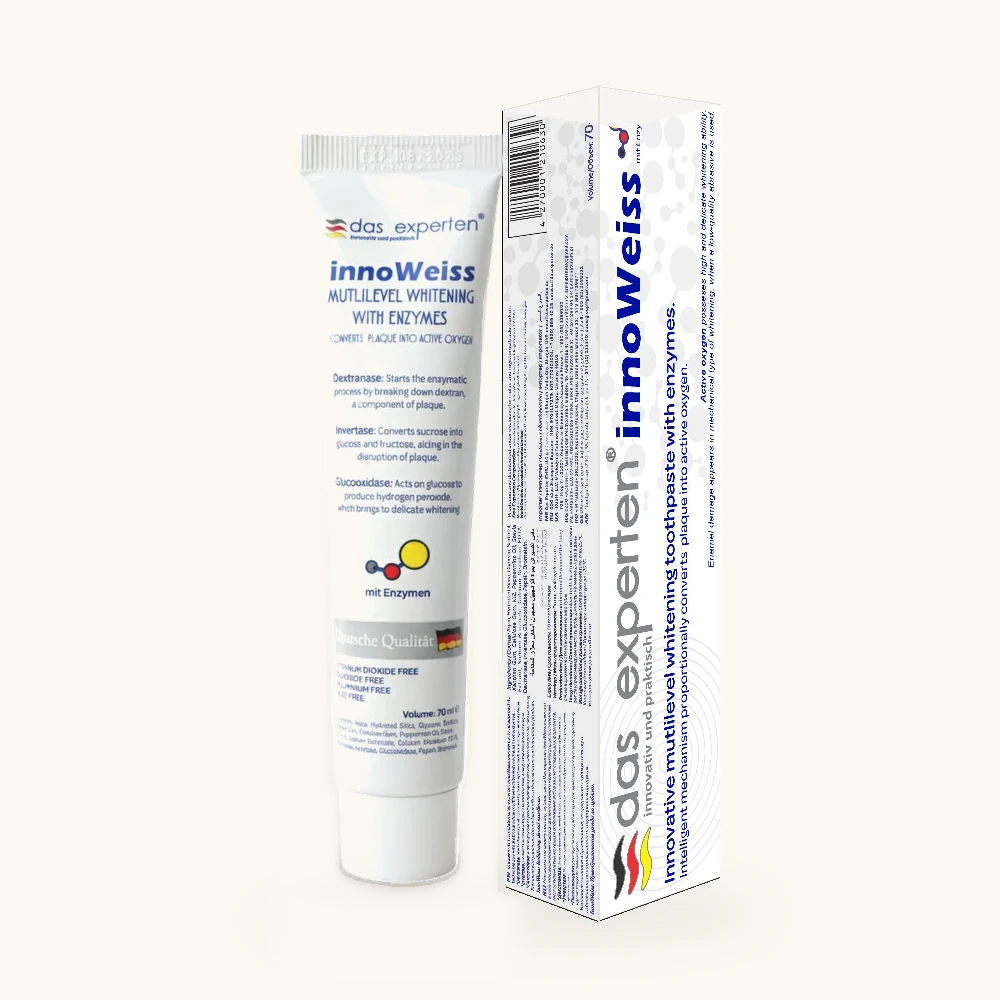
Looking for a dextranase toothpaste, not only the research? INNOWEISS lists dextranase with invertase, glucose oxidase, papain and bromelain. These are formulation facts; the purchase action is not proof of a clinical outcome.
View INNOWEISS detailsDental plaque is a structured microbial community within a matrix containing glucans, proteins and extracellular DNA. Dextranase can cleave alpha 1,6 bonds in dextran, which makes it a plausible matrix targeting ingredient. The evidence boundary matters: most published work uses simplified laboratory biofilms, enzyme concentrations and contact times that differ from two minute brushing. Results for an isolated enzyme cannot automatically be transferred to a retail formula.
Mechanism
How dextranase interacts with plaque biofilm
| Step | What happens |
|---|---|
| 1. Biofilm forms | Oral bacteria metabolize dietary sugars and produce dextran, building a sticky matrix |
| 2. Matrix adheres | The dextran matrix binds plaque biofilm and trapped stain particles to the enamel |
| 3. Dextranase acts | Dextranase breaks down the dextran polysaccharide bonds within the matrix |
| 4. Biofilm is measured | Laboratory models measure whether treated biofilm is inhibited or removed |
What the evidence supports
- A plausible matrix degrading mechanism supported mainly by in vitro research.
- Potential use alongside other enzymes with different biochemical targets.
- A non biocidal research route that does not depend on killing oral bacteria.
Limitations
- The 2024 systematic review found mostly simplified in vitro models and treatment times of at least 30 minutes; normal brushing is much shorter.
- Ingredient studies do not prove plaque reduction, cavity prevention, whitening or lower abrasion for a finished toothpaste. Dextranase does not replace brushing, interdental cleaning or fluoride advice from a dental professional.
Research versus product evidence
A 2024 systematic review found that dextranase and mutanase could inhibit or remove cariogenic biofilms in vitro, while stressing simplified models, moderate risk of bias and generally long exposure times. An older human study investigated dextranase mouthwash, not INNOWEISS and not this toothpaste format. INNOWEISS lists dextranase, invertase, glucose oxidase, papain and bromelain; that formulation fact does not by itself establish a clinical outcome.
FAQ
What does dextranase actually break down?
Dextranase hydrolyses alpha 1,6 bonds in dextran. Dental biofilm matrices contain several components, so describing dextran as the whole of plaque glue is an oversimplification.
Is dextranase the only enzyme that matters in enzyme toothpaste?
No. The relevance of any enzyme depends on its activity in the finished formula, dose and brushing contact time. More enzymes do not automatically mean better clinical results.
Which Das Experten product contains dextranase?
INNOWEISS includes dextranase as part of its five enzyme cascade: dextranase, invertase, glucose oxidase, papain and bromelain.
Related
The Science hub · What Is an Enzyme Toothpaste? · Which Enzymes Remove Plaque? · INNOWEISS product page