


Yellow Teeth With Age: The Colour No Toothpaste Can Reach
This week a buyer asked us a short question under a tube of our whitening paste: will it help teeth that have darkened over the years? It is one of the most honest questions anyone can ask about yellow teeth, and it deserves an honest answer, including the part that does not sell anything. Because the colour you notice in the mirror at sixty is mostly not on your teeth. It is inside them.
Teeth darken with age, and it has been measured
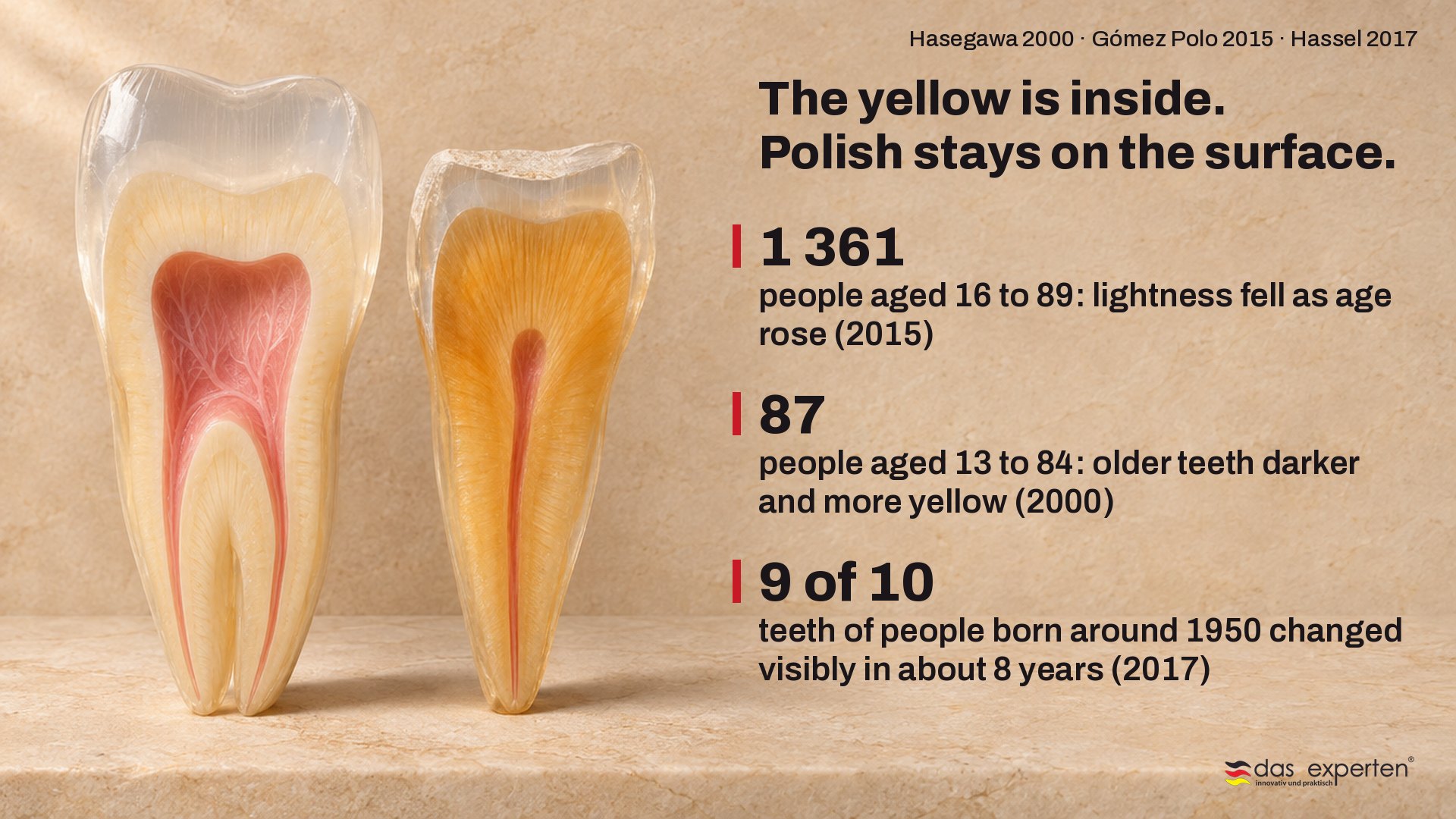
This is not a feeling. In 2000 a Japanese team measured the front teeth of 87 people aged from 13 to 84 with a colour instrument. The result was a straight line: the older the person, the darker and the more yellow the centre of the tooth. In 2015 a Spanish team did the same with 1 361 people aged from 16 to 89. Of every colour measure they took, lightness had the strongest link with age: it fell, and yellowness rose, decade after decade.
Then a team in Heidelberg did the cleverest thing. Instead of comparing young people with old people, it measured the same 106 front teeth of the same 61 people twice, about 8 years apart. In the group born around 1950, roughly 9 teeth in 10 had changed colour by more than the amount an observer accepts as the same shade. So if you think your smile has shifted, you are probably right.
Why the yellow is inside the tooth
A tooth is built like a lamp shade over a bulb. The outer layer, enamel, is hard and partly translucent. Under it sits dentine, a softer, naturally yellower tissue that makes up most of the tooth. What you see as tooth colour is light passing through the enamel, scattering in the dentine and coming back out.
Age changes both layers. Researchers in Bern describe it plainly: decades of chewing and acid wear the enamel thinner. At the same time the tooth keeps laying down new dentine from the inside, called secondary dentine, and the tiny channels in the old dentine fill with mineral. The pulp chamber at the centre shrinks. The usual explanation follows from that anatomy: a thinner shade over a denser, yellower core lets more of the core show through. Nobody stained it. The tooth grew into it.
What a toothpaste can and cannot do
Here is the honest part. A toothpaste works on the surface. It can lift the film that coffee, tea and red wine dye, and on many people that film is a real part of the darkness they see. It cannot reach the dentine under the enamel, and no paste that is safe to brush with twice a day can bleach it.
That is exactly what we told the buyer about our INNOWEISS. Its papain and bromelain break down the protein film where pigments from coffee and tea anchor, dextranase breaks up the scaffold of plaque, and its silica base sits below 30 on the RDA abrasion scale, so it does not polish the enamel away to look brighter. It cleans off what sits on the tooth. It does not change the colour the tooth is made of.
For that colour, the NHS route is professional whitening: a dentist checks your teeth and gums, then you wear a gel in fitted trays at home for about 2 to 6 weeks, and the effect may last around 3 years. It lightens natural teeth only, never crowns, dentures or implants. And one tooth that darkens on its own, much faster than its neighbours, is a different question that belongs with a dentist.
How to read your own mirror
Do one simple test before you buy anything. Take a photo of your teeth today, by the same window, at the same hour, without a filter. Brush gently with a low abrasion paste for a few weeks and take the same photo again. Whatever came off was surface film. Whatever stays is the colour of you at this age, and a 2021 study from King's College London explains why that bothers us: people judged faces with whiter teeth to be younger.
Your teeth are not dirty, they are older, and that is a different problem with a different answer. Clean the surface gently every day, and take the colour inside the tooth to a dentist, not to the toothpaste aisle.