


Ozempic Teeth: 31 195 Reports, and Not One Trial Looked Inside the Mouth

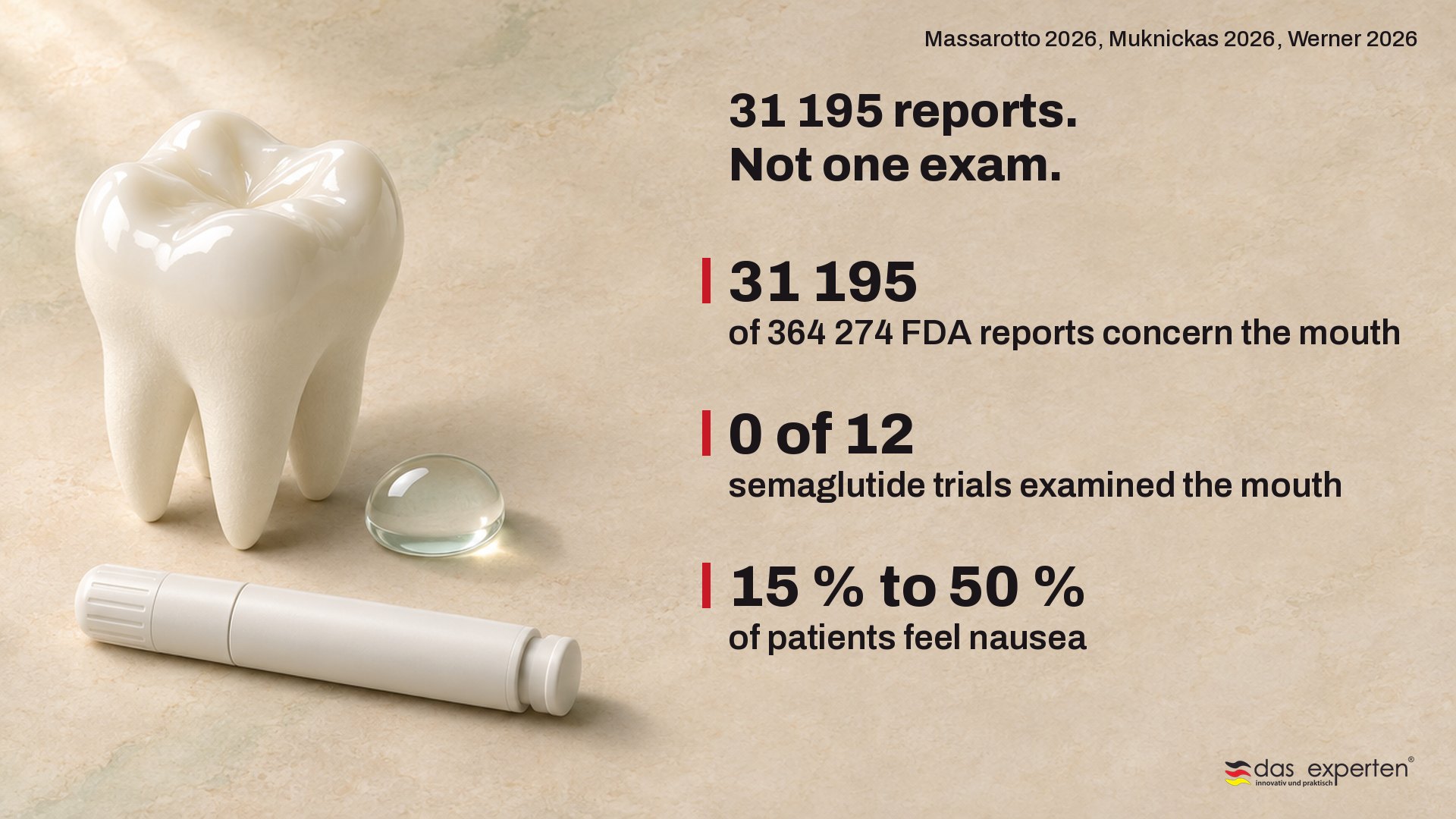
Somewhere in the United States right now a pharmacist is handing over a weekly injection pen, and nobody at the counter is talking about teeth. Why would they? The drug is for blood sugar or for weight. Yet between the first approval of these medicines and December 2025, the American drug safety database collected 364 274 reports of side effects for five of them, and 31 195 of those reports, 8.6 %, concerned the mouth, the face or the teeth.
That number comes from one of three papers published in the past five weeks, all asking the same question: what do GLP 1 drugs such as Ozempic, Wegovy and Mounjaro do inside your mouth? Here is what each found, by date, and where the evidence simply stops.
14 October: Munich counts how little we know
A team at the LMU University Hospital in Munich, led by the periodontist Falk Schwendicke, reviewed everything dentistry knows about GLP 1 receptor agonists, the drug class behind these pens, in the Journal of Dental Research. Their starting point is scale: prescriptions for obesity treatment rose by 587 % between 2019 and 2024. Their finding is a gap. In cells and in animals the drugs look kind to gums and bone: less inflammation, less bone loss around the teeth, better healing around implants in diabetic rats. In people there is only a single retrospective study. And not one prospective study has used any dental outcome as its endpoint.
The same review names the plausible risk. Nausea hits 15 % to 50 % of patients and vomiting 5 % to 24 %, with reflux on top. Stomach acid on enamel is a known way to lose it. Whether it happens on these drugs, and how often, nobody has measured.
27 October: Rochester reads the complaint box
The 31 195 mouth reports come from the Eastman Institute for Oral Health at the University of Rochester, published in JDR Clinical and Translational Research. The team screened the FDA Adverse Event Reporting System for exenatide, liraglutide, semaglutide, dulaglutide and tirzepatide. Tirzepatide, one of the newest, produced the most reports overall. Semaglutide, the molecule in Ozempic and Wegovy, had the largest share of reports about the mouth, and the only drug specific signal for dry mouth. Vomiting, regurgitation and reflux stood out for all five drugs. Taste changes stood out for several, and dry mouth tended to travel together with a distorted sense of taste.
A signal is not a rate. Anyone can file a report, nobody counts the people who felt fine, and a famous drug collects more letters simply because more people talk about it. What a signal does is tell researchers where to dig.
14 November: Saarland checks the trials
The newest paper, from Saarland University in Germany, published in BMC Oral Health, went to the strongest evidence there is: randomised controlled trials of semaglutide. Out of 630 records the team kept 12 trials, running 21 to 68 weeks. Nausea was reported in 12 of them and diarrhoea in 11. Tooth decay appeared in 1. Dry mouth appeared in 1. Then the sentence that matters: none of the included studies directly investigated oral or dental outcomes. Nobody looked, so nobody can say.
And the one hopeful number?
In September a group in Taichung, Taiwan, compared 97 993 adults with type 2 diabetes on tirzepatide against the same number on older GLP 1 drugs. Over a year, the tirzepatide group had fewer recorded cases of gum disease, by about 30 %, and fewer tooth extractions. It compares one drug with another, not with no drug, it rests on health records, and the authors themselves ask for prospective studies with real dental examinations.
What “Ozempic teeth” really means today
“Ozempic teeth” is an internet phrase, not a diagnosis. The honest summary of these papers is an asymmetry: millions of people take the drugs, thousands complain about their mouths, and the trials that would settle it were never designed to look. Absence of evidence here is not evidence of safety. It is simply absence.
The Rochester authors suggest what clinicians can already do: ask about these medicines, watch for dry mouth, taste changes and reflux, and advise on hydration, saliva substitutes and diet. For you that means one practical thing. If you have started a weekly pen, tell your dentist at the next visit, the same way you would mention any other medicine.
31 195 reports about the mouth, 12 trials that never examined it. Until someone looks, your dentist is the only person checking.