





Hydroxyapatite vs Fluoride: Why 2026’s Trials Keep Tying
You are standing in front of a shelf. Two tubes. One says fluoride, which your dentist has recommended since you had milk teeth and which a loud part of the internet now treats as a scandal. The other says hydroxyapatite, which sounds like something a laboratory would say, and costs more. You have maybe eleven seconds and no way to check. This is the position the industry has arranged for you, and over the past six weeks four separate research groups published work that makes it considerably worse — not because they found a winner, but because they kept failing to.
The interesting question is no longer which molecule wins. It is why four studies, run in four countries on different teeth under different protocols, all arrived at roughly the same shrug — and what that shrug is telling you about where the difference in your mouth is actually being made.
Five children’s toothpastes, five different heroes, one statistically boring result
On 2 September 2026, Medical Principles and Practice published a comparison of five commercial paediatric toothpastes, each built around a different headline active: fluoride, hydroxyapatite, ozone, propolis and postbiotics. Forty-eight specimens cut from extracted third molars. Baseline microhardness, then four days in demineralising solution, then fourteen days of pH-cycling at 37 °C with the paste applied twice a day — roughly what your bathroom does to your enamel, compressed. Every one of the five produced statistically significant remineralisation of the early lesions, p < 0.05. There was a ranking. And the differences between them were not statistically significant, p > 0.05.
Read that twice. A ranking existed and it meant nothing: the distance between first place and last was noise. The only difference in the entire experiment that reached significance was antibacterial — one formulation’s inhibition zone against Streptococcus mutans, wider than one other’s. That is the whole harvest. One bacterium, one comparison, out of five products and four organisms.
The fluoride-free paste matched the fluoride paste — then the microscope disagreed with the number
Four weeks earlier, on 4 August, the European Journal of Dentistry put sixty human premolars through a seven-day pH-cycling protocol. Two fluoride-free bioactive formulations — one carrying nanohydroxyapatite with calcium phosphate and antibacterial agents — against a fluoride-containing functionalised tricalcium phosphate paste. On the numbers the study was built to produce, the percentage of resistance to demineralisation and the anti-demineralisation potential, the fluoride-free formulation and the fluoride one were comparable. Statistically, a tie.
Then they looked. Scanning electron microscopy showed the nanohydroxyapatite formulation preserving enamel architecture better than either comparator. Atomic force microscopy showed its crystals packed more densely and oriented better. Polarised light microscopy put it first on demineralisation prevention outright. Same experiment. The hardness reading said tie; the three instruments that look at structure did not. When your instrument measures hardness you learn about hardness, and then you quietly conclude about teeth. The number is not the tooth. The number is what survived the translation.
What seven randomised trials forgot to write down
On 24 August a systematic review in the European Archives of Paediatric Dentistry screened 320 papers on relieving the hypersensitivity of molar-incisor hypomineralisation and found seven that qualified, every one a randomised controlled trial. Fluoride toothpaste. Hydroxyapatite toothpaste. CPP-ACP paste. Photobiomodulation. Silver diamine fluoride. Fissure sealants with and without it. Reinforced glass ionomer. Every treatment reduced sensitivity against baseline. Every single one.
The reviewers’ own verdict on their own evidence is the part worth keeping: limited. No blinding. Small samples. And — this is the line that should change how you shop — no information on the patients’ previous daily hygiene habits. Seven trials, and not one recorded what the patients were already doing twice a day. The asymmetry is the point. Measuring the agent is cheap: you buy it, you apply it, you read the instrument. Measuring the habit is slow, expensive and unglamorous, so it goes unmeasured, so it vanishes from the conclusion, then from the shelf, then from your decision. The variable most likely to be doing the work is the one nobody is paid to observe.
Then a virus turned up in the plaque, and the rules changed depending on where the bacteria were sitting
On 8 September, in the Proceedings of the National Academy of Sciences, a group from the ADA Forsyth Institute with the University of Washington and Stony Brook reported the first bacteriophage ever found to target a Candidate Phyla Radiation bacterium. The CPR — the Patescibacteriota — are ultrasmall bacteria with stripped-down genomes that cannot live alone; the one in question, TM7x, rides on the surface of a host bacterium in your mouth. The phage, Xhp1, sits inside that host’s genome and wakes preferentially while TM7x is riding.
Here is the finding that belongs on a bathroom mirror. Whether Xhp1 kills or lies quiet is decided neither by the phage nor by the bacterium. It is decided by where they are. In free-floating culture it establishes lysogeny and does nothing. On a surface — anchored, built into the architecture of a biofilm — it turns lytic and kills. Same mouth, same species, same virus. The outcome turns on whether the cells are drifting or built into something. Your plaque is not a quantity of bacteria. It is an address, and the address changes the biology.
Four papers, four countries, one thing none of them will admit to being about
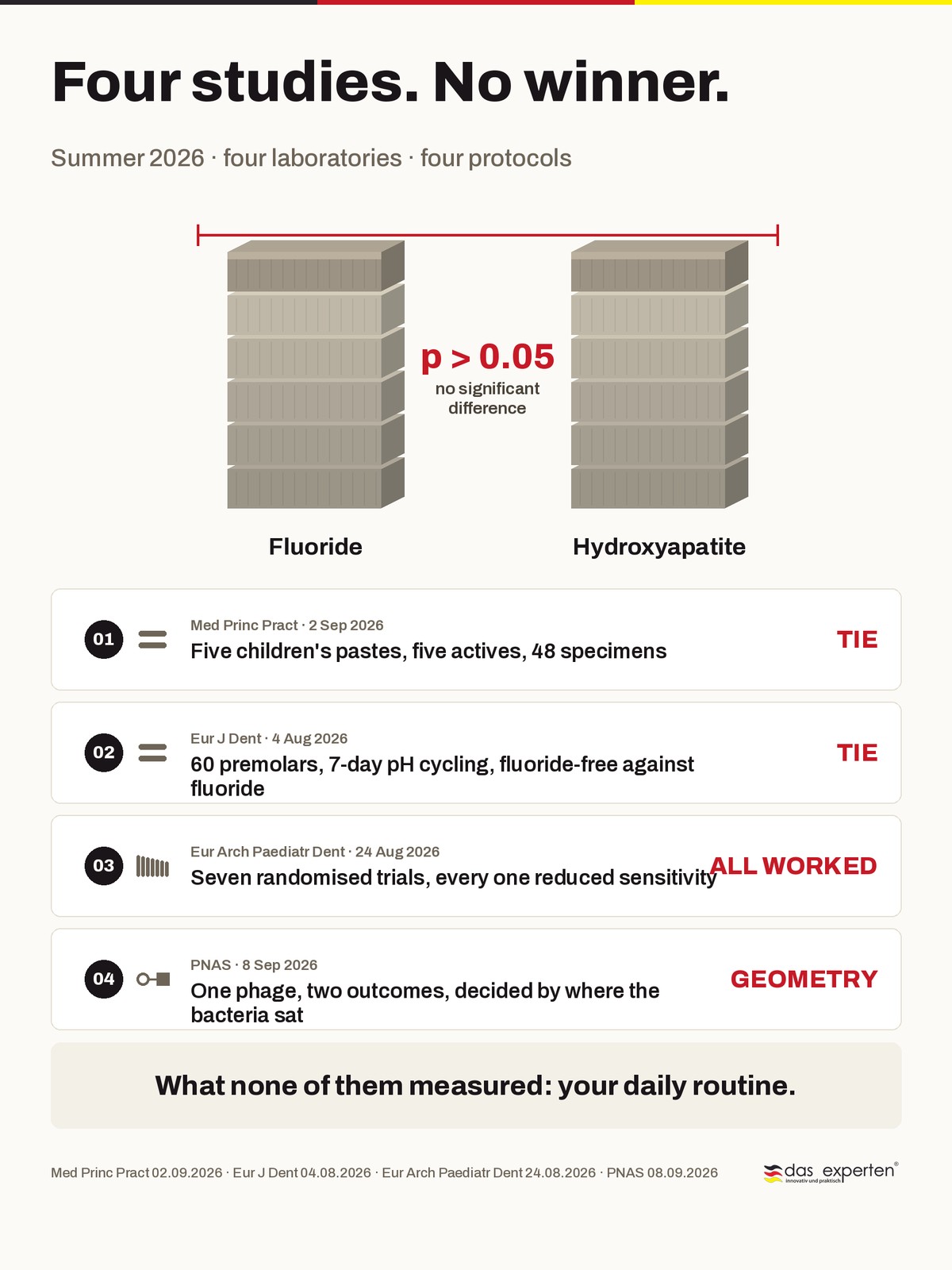
Put the four together and they rhyme in a way none of them says out loud. In the paediatric comparison the active did not decide. In the premolar study the number tied and the architecture separated. In the systematic review every agent worked and the routine was never written down. In the plaque, one virus was harmless or lethal depending on geometry. Four times, the variable that mattered was not the molecule on the front of the tube. It was structure, position, arrangement, repetition — the boring things, which do not photograph well and cannot be set in a larger font.
That is the assumption Das Experten SYMBIOS is built on, and it is worth stating as an assumption rather than a proof. The paste carries Bacillus coagulans, strain JYBC-016, at 4×10¹⁰ CFU per dose. The organism is spore-forming, which is the only reason the claim is possible at all: it survives the tube and activates at oral temperature, 37 °C, and salivary pH 6.8–7.4. It is fluoride-free and SLS-free — the surfactant is LS30, sodium lauroyl sarcosinate 30%. There is xylitol in it. And there is no broad-spectrum antimicrobial in the formula, which is the actual design decision. If the PNAS result tells you anything about a mouth, it is that you are not managing a contaminated surface but a community with its own predators and its own geography — and a formula that sterilises it indiscriminately is not neutral. It is an intervention with a direction, and nobody has shown you the direction.
And yes — that argument cuts against my own tube as hard as anyone else’s. If the active is not the variable, then B. coagulans is not the variable either. What it is, is a formula that declines to fight the geography.
So the eleven seconds in front of the shelf were never the decision. The decision is the two minutes, twice a day, that not one of those seven trials thought to write down — and you have been making it, unrecorded and unsupervised, since you were about seven years old.
Choose the tube in eleven seconds. You have already spent forty years on the part that counts.