


How to Stop Bleeding Gums: China Wrote the Answer as Table Manners
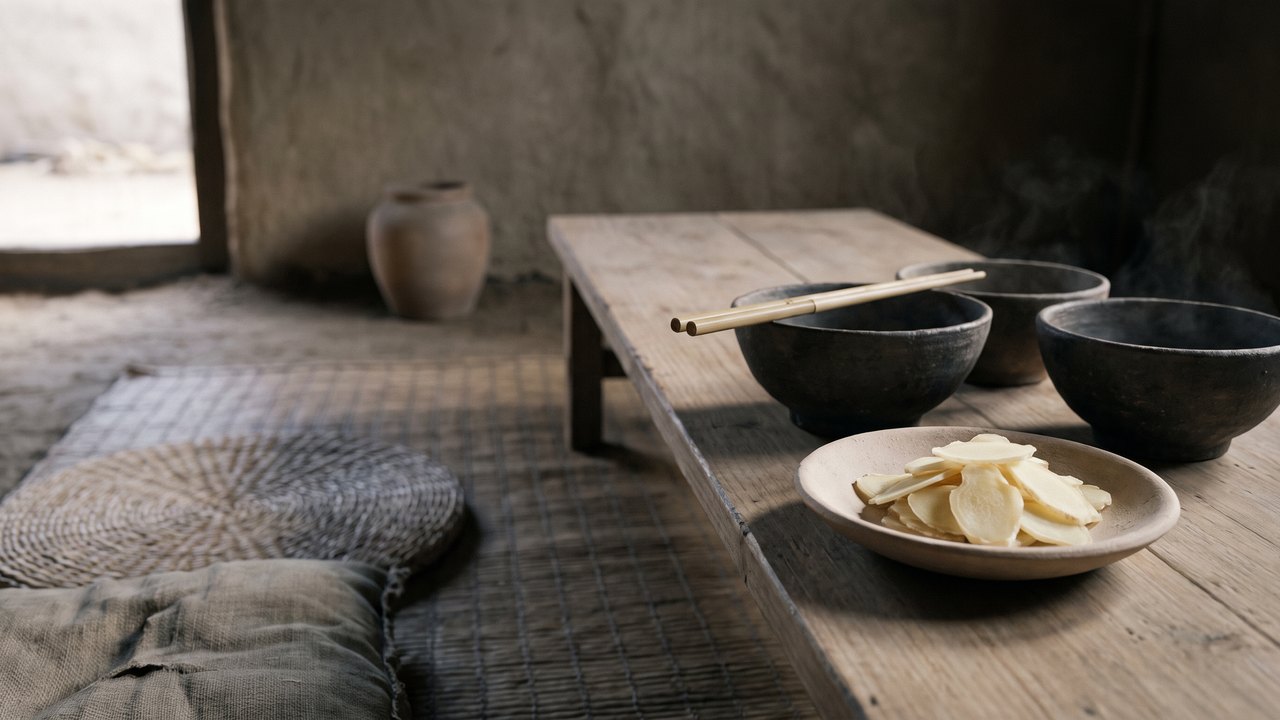
A meal in the state of Lu, somewhere around 500 BC. Millet, steamed. Meat cut fine. Every dish with its own sauce, and nothing eaten without it. The room is cold enough to see breath, and the old man at the low table is eating less than anyone expects, and saying nothing, because he does not talk while he eats.
Then, at the end, he reaches for the one dish that is never carried away with the rest. Fresh ginger, shredded thin, pale yellow. He takes a little. His mouth stings and floods with water, and the taste of the meal, fat, fish, stored grain, is gone in about ten seconds.
Nobody asks him why. The men watching write it down anyway, because they write everything down: how he stood, how he dressed in which month, what he refused to eat when it was out of season. What survives is four characters long, and it is phrased as a negative.
不撤薑食. He did not remove the ginger.
One civilisation kept a dish on the table. The other kept a jar.
For the next few centuries, the Mediterranean, the half of the world that would later write the textbooks, had a different idea about the inside of the mouth.
Diodorus Siculus records that the Celtiberians of Spain washed their teeth and gums with stale urine, and considered it good care. Catullus built a whole poem out of it, mocking a Spaniard called Egnatius who smiled at funerals with teeth polished that way. This was not a fringe habit at the edge of the empire. Ammonia cleans, and Rome knew it: the fullers collected urine in jars on the street corners to scour cloth.
So while one table kept a small heap of ginger next to the food, the other reached for the jar. Both were empirical. Only one of them was right for a reason that would still be right two and a half thousand years later.
They had no word for bacteria. They had a kitchen.
There was no theory behind the ginger, and that is the point. Ginger was already the thing a Chinese cook reached for to kill the smell of fish and mutton, 去腥, to take the rankness out. Move that from the pot to the mouth and the same thing happens, and you do not need to know why. A man who eats ginger after fish has a mouth that does not smell of fish. A man who eats it every day for forty years has gums that behave differently, and nobody in the room has any way of connecting those two facts.
Around 1170, the philosopher Zhu Xi finally wrote the reason down, and his reading of the Analects then became the text every candidate for the imperial examinations had to know for the next five hundred years. Six characters: 薑,通神明,去穢惡, ginger opens the spirit brightness and drives out the foul.
Here is the strange part. The sentence was never lost. It was memorised by essentially every literate person in East Asia for twenty five centuries. It was simply filed in the wrong drawer. Book X of the Analects is a chapter about conduct, how the Master bowed, what he wore, what he would not touch, so the one habit that would have mattered arrived inside a list of manners. And it arrived as a negative: a thing that was never taken away. Nobody writes down what never changes. Generations of commentators argued about the grammar, whether he ate ginger at every meal or merely kept it within reach, and the pharmacology sat in the open the whole time, unread, because the words carrying it, spirit brightness, foulness, were not words a Western physician was ever going to put in a trial.
The spice crossed the world. The reason stayed behind.
Ginger itself had no trouble travelling. It reached Rome as a taxable Eastern import and was listed by name among the goods duty was charged on. It was in Dioscorides. By the Middle Ages it was in every serious European kitchen, one of the ordinary luxuries, and it stayed there, as a flavour. The cargo moved west; the observation did not. Europe bought the root and left the sentence in Lu.
The catch up took until the modern laboratory. In 2008, Park, Bae and Lee isolated [10] gingerol and [12] gingerol from the ginger rhizome and tested them against anaerobic oral bacteria. Both compounds inhibited the growth of Porphyromonas gingivalis, the organism that sits at the gum margin and drives periodontal disease. The paper ran in Phytotherapy Research. It does not mention Confucius.
That result matters because of what bleeding gums actually are. A gum does not bleed because you brushed too hard. It bleeds because it is inflamed, and it is inflamed because a film of anaerobes has been living undisturbed where the gum meets the tooth. Blood in the sink is not a clotting problem you have to be gentle with. It is a bacterial problem you have been treating as clumsiness.
![They had no word for bacteria. They had a kitchen. A gum does not bleed because you brushed too hard. It bleeds because it is inflamed. c. 500 BC: state of Lu: the ginger dish is never carried away; Catullus: mocks Egnatius, teeth polished with urine; c. 1170: Zhu Xi writes the reason down: ginger drives out the foul; Middle Ages: in every serious European kitchen, as a flavour; 2008: Park, Bae and Lee: gingerols inhibit P. gingivalis. two and a half thousand years. He did not remove the ginger: four characters, phrased as a negative, in a chapter about conduct. The other kept a jar: Roman fullers collected urine in jars on street corners; ammonia cleans. [10] and [12] gingerol: isolated from the rhizome, both inhibited the growth of Porphyromonas gingivalis. Why a gum bleeds: a film of anaerobes living undisturbed where the gum meets the tooth. Memorised for twenty five centuries, filed as table manners. The cargo moved west; the observation did not. Bleeding that does not settle in about two weeks: a dentist, this week. Blood in the sink is not a clotting problem. It is a bacterial problem.](/assets/blog/lu-ginger-dish-500-bc/bleeding-gums-confucius-ginger-infographic-en.jpg)
Tomorrow morning you will spit, and you will explain it away again
You already know the moment. You rinse, you look down, there is pink in the water, and you decide within about half a second that you were brushing too hard, or the floss caught, or you are tired. Then you go to work. That decision is the one you have been making, quietly, for years, and it is a decision, even when it feels like nothing at all.
GINGER FORCE from Das Experten is the dish from that table, measured out. Zingiber officinale root extract at 1%, carrying the gingerols and shogaols. Over 14 days it reduces Porphyromonas gingivalis by 65 to 79% on the gingival index and cuts biofilm by 40 to 60%. It also lifts salivary flow by 26 to 40% through TRPV1, that is the receptor behind the sting, the same flood of water the old man got at the end of his meal, and saliva is what rinses and buffers the gum line all day. It carries sodium pyrophosphate, which slows soft deposit hardening into tartar, and it is fluoride free and SLS free. There is nothing in that tube that Confucius would have recognised except the one thing that does the work.
And the honest half. If the bleeding does not settle within about two weeks, or a tooth has started to move, that is not a paste problem, that is a dentist, this week, not next month. Hardened tartar comes off with an instrument and with nothing else. What you actually control is whether the film that inflames the gum gets to sit there for another day.
Start tomorrow morning. Not because it is ancient, and not because it is natural, because the molecule was named, isolated and tested, and it turned out to be the one that was on the table all along.
The answer to bleeding gums was written down two and a half thousand years ago, memorised by half the world, and read as a note about table manners.