


Can Gum Disease Affect Your Brain? Three New Studies on Gum Disease and Dementia

If your gums have ever bled a little when you brushed and you thought nothing of it, last week's research has a question for you. Three studies published between 26 and 30 October 2026 came at the same uncomfortable idea from three directions: that gum disease and dementia, the health of your gums and the health of your memory, may travel together. None of them proves that one causes the other. Read carefully, they say something more useful than a scare.
Study 1: gum disease at 58 and the brain's warning signs
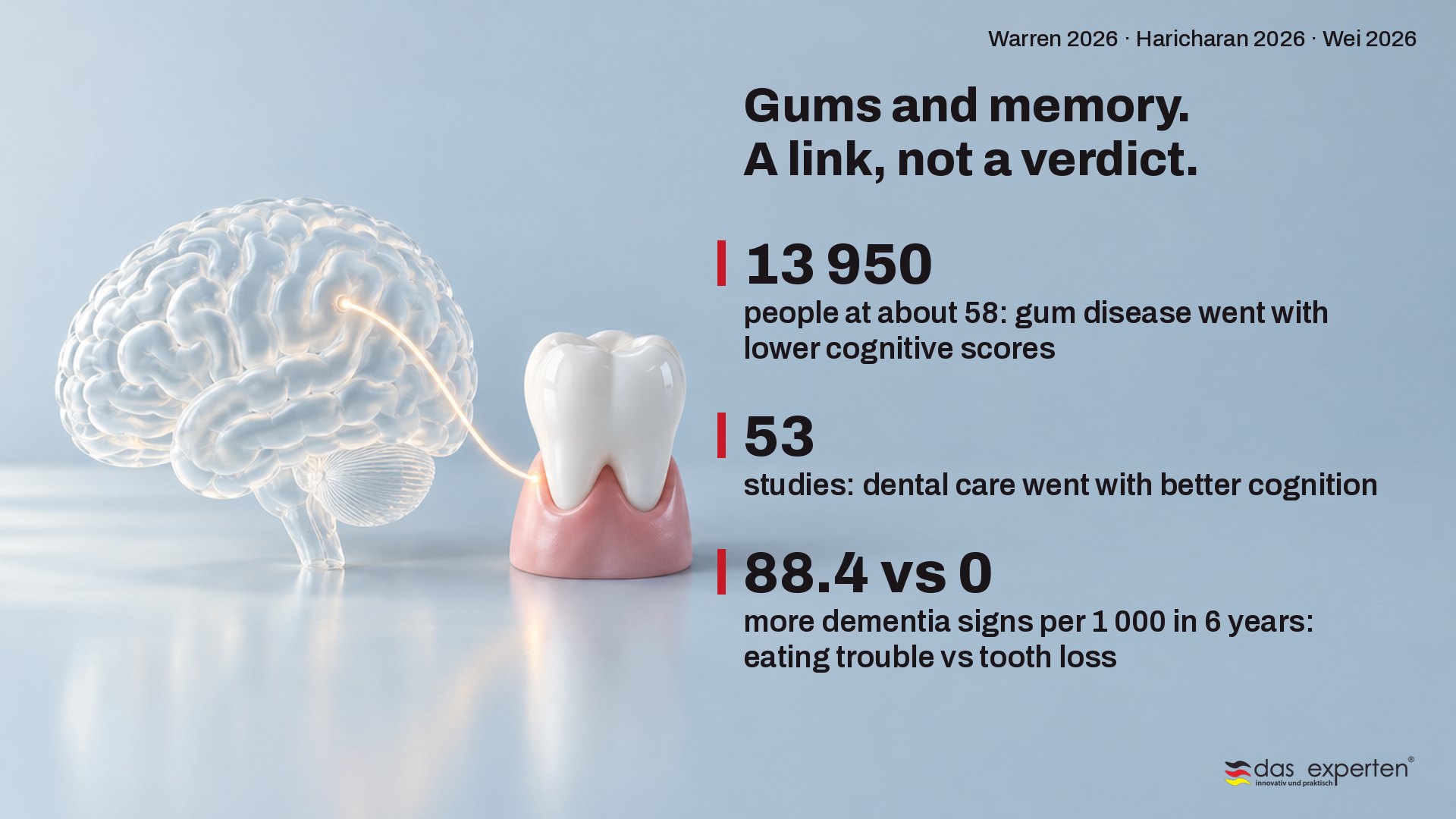
On 30 October the Journal of Periodontology published work by John Robert Warren of the University of Minnesota and colleagues. They used High School and Beyond, an American cohort of about 26 830 people who were in high school in 1980 and were followed into midlife in 2021. The team analysed 13 950 of them, with a mean age of 58. 15.2 % said they had been diagnosed with periodontal disease, the deep form of gum inflammation that destroys the tissue holding the teeth in place.
Those people scored lower on general cognitive functioning and on some specific thinking tasks. Their blood also carried more pTau 181, a phosphorylated tau protein used as a marker of Alzheimer's risk, and more C reactive protein (CRP), a general signal of inflammation. The pattern looked the same in men and women, across racial and ethnic groups, and whatever the number of APOE ε4 genes a person carried, the best known genetic risk for Alzheimer's disease.
Now the honest part. After correcting for the many comparisons tested, only working memory stayed below a false discovery rate of 10 %. The gum disease was reported by the participants themselves, and everything was measured at a single moment. This is an association, not a cause.
Study 2: 53 studies on whether dental care changes the course
On 27 October a team from McGill University in Montréal (Haricharan, Nicolau, Feine and colleagues) published a scoping review in JDR Clinical and Translational Research. They searched four databases up to 11 April 2025 and mapped 53 studies of adults aged 45 or older with tooth loss or other oral conditions.
Regular dental visits were mostly linked to a lower risk of dementia, although some studies found no link at all. Dentures that fit well, especially dentures held by implants, went with better cognitive function, probably through better chewing and nutrition. Implants and crowns were consistently linked to better cognitive scores. Treatment of gum disease showed the most consistent benefit, with less inflammation in the body and a lower risk of dementia. The authors are clear about the limit: almost all of this evidence is observational, and the studies define both dental care and cognition in very different ways.
Study 3: the warning sign is not the missing tooth
On 26 October the Journal of Dentistry published the largest of the three. Wei and colleagues, led from Xiamen University, joined four ageing studies from China, England, the United States and Europe: 219 047 people and 722 637 survey rounds. They asked a sharp question: does a new problem with eating or with teeth come before a sudden fall in thinking?
Over 6 years, people who newly reported difficulty eating had 91.5 more dementia indicators per 1 000 than matched peers, and 88.4 after adjustment. For tooth loss or poor dental health the figure was 13.5 before adjustment, statistically indistinguishable from zero, and about 0 after it. When eating difficulty came together with another limitation in daily life, the gap reached 105.1 per 1 000; when it was reported again at the next round, 202.1. There was no sudden acceleration of decline, and the arrow also pointed backwards: low cognition predicted eating trouble later. The authors' conclusion is that difficulty eating marks a wider frailty, and that a dental check on its own is not a dementia test.
What the three studies say together
Side by side, the picture is consistent and modest. Inflamed gums travel with slightly weaker thinking and with inflammatory signals in the blood. Looking after the mouth goes with better cognitive outcomes. And a person who suddenly finds meals hard is telling the people around them something about their whole health, not only about their teeth. What none of the three can show is that treating your gums will protect your memory. That needs trials that follow people forward in time, and at the scale needed they do not exist yet.
What to do with this on a Monday morning
You do not need a brain study to justify brushing. Gum disease is worth stopping for its own sake: it is a leading reason adults lose teeth. Gums that bleed when you brush, gums that pull back, a tooth that has started to move: each is a reason to book a dentist, not to wait. Brush twice a day for two minutes, clean between your teeth, and keep your regular checkup. And if an older parent begins to avoid food, chews on one side or leaves meals half eaten, do not file it under teeth alone. Tell their doctor as well.
Your gums will not decide your memory. But they are the one part of this story you can start working on tonight.